The 7 Chakras Explained: Colours, Meanings and the Importance of Chakra Balancing
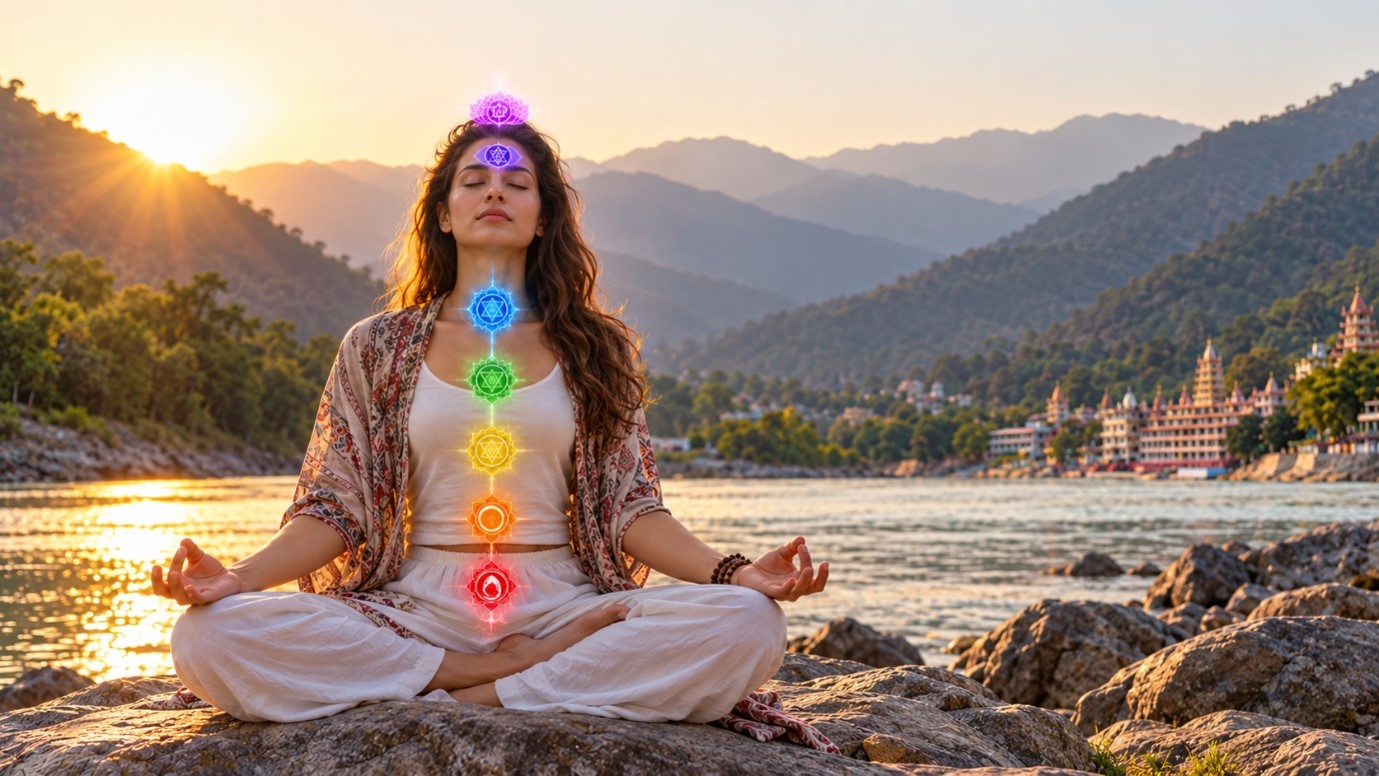
You may have seen the seven chakras shown as seven coloured centres along the body.
You may have also heard people talk about a blocked Root Chakra, an open Heart Chakra, or balancing the Third Eye.
But what exactly are chakras?
What do the seven chakras represent? Why are they associated with different colours? And what does chakra balancing actually mean?
For many people, chakra work begins as a spiritual practice. For others, it becomes a way of understanding their emotions, patterns, relationships, and connection with themselves.
In the yogic and Tantric traditions, chakras are described as centres within the subtle body. They are not physical organs. Different traditions describe different numbers and arrangements of chakras, so the familiar seven chakra system should be understood as one particular framework within a much larger body of teachings.
For me, chakra awareness is not about trying to force something open.
It begins with learning to notice.
Table of Contents
What Are Chakras?
The Sanskrit word chakra is commonly translated as “wheel” or “circle.”
In yogic and Tantric traditions, chakras are described as subtle centres within the subtle body.
They are connected with a larger system that includes the nadis, prana, kundalini, mantras, elements, deities, symbols, and different states of consciousness. Traditional systems can vary considerably in their descriptions. Some texts describe five or six main chakras, while other systems include seven or more.
The seven chakra system has become particularly familiar in modern yoga and meditation.
It includes:
- Muladhara, the Root Chakra
- Svadhisthana, the Sacral Chakra
- Manipura, the Solar Plexus Chakra
- Anahata, the Heart Chakra
- Vishuddha, the Throat Chakra
- Ajna, the Third Eye Chakra
- Sahasrara, the Crown Chakra
It is useful to remember that these are part of a traditional subtle body model. They should not be treated as physical organs or anatomical structures.
Understanding the Seven Chakra System
The seven chakras can be understood as a journey from the more grounded aspects of human experience towards subtler forms of awareness.
The lower centres are commonly associated with grounding, embodiment, emotions, desire, action, and personal power.
The middle centres bring attention towards connection, compassion, communication, and inner perception.
The upper centres are traditionally associated with concentration, spiritual awareness, contemplation, and consciousness.
This does not mean that one chakra is more important than another.
A spiritual practice still needs grounding.
And grounding without awareness can also become limiting.
Balance comes from learning to work with the whole system.
The 7 Chakras at a Glance
| Chakra | Sanskrit name | Common colour | Traditional themes |
|---|---|---|---|
| Root | Muladhara | Red | Grounding, stability, security |
| Sacral | Svadhisthana | Orange | Emotion, creativity, flow |
| Solar Plexus | Manipura | Yellow | Will, confidence, transformation |
| Heart | Anahata | Green | Love, compassion, connection |
| Throat | Vishuddha | Blue | Expression, communication, truth |
| Third Eye | Ajna | Indigo | Awareness, perception, concentration |
| Crown | Sahasrara | Violet or white | Consciousness, spirituality, contemplation |
The familiar colour system is widely used in contemporary chakra practices. However, traditional chakra systems contain much more elaborate symbolism, including lotus petals, seed syllables, elements, deities, geometric forms, and other correspondences.
1. Root Chakra: Muladhara
Muladhara is traditionally associated with the base of the body and with grounding, stability, embodiment, and a sense of support.
Think about how you feel when life becomes uncertain.
Do you become restless?
Do you find it difficult to slow down?
Do you feel disconnected from your body?
Do you constantly feel that you need to move on to the next thing?
Root Chakra practices can bring attention back to the physical body.
Walking, mindful movement, grounding practices, slow breathing, and awareness of the feet and legs can all be used as ways of developing this connection.
The practice is not about convincing yourself that everything is safe.
It is about learning to notice how you experience the present moment.
2. Sacral Chakra: Svadhisthana
Svadhisthana is traditionally associated with the lower body and with themes such as emotion, creativity, movement, pleasure, and fluidity.
Our relationship with emotions can be complicated.
Some of us express everything immediately.
Some of us suppress almost everything.
Some people find it difficult to receive pleasure or simply allow themselves to enjoy life without guilt.
Sacral Chakra practices can create a space to observe these patterns.
Gentle movement, meditation, breath awareness, creative expression, and practices that help us connect with bodily sensations can all become part of this exploration.
The goal is not to become controlled by emotion.
It is to become more comfortable experiencing emotion without immediately reacting to it.
3. Solar Plexus Chakra: Manipura
Manipura is traditionally associated with the fire element and with themes of will, transformation, confidence, discipline, and personal power.
This is an interesting area to explore when we look at our relationship with action.
Do you struggle to make decisions?
Do you constantly look for approval?
Do you find it difficult to say no?
Or do you push yourself even when your body is asking you to stop?
Working with Manipura can bring awareness to these patterns.
Personal power does not always mean becoming stronger or more forceful.
Sometimes it means being able to act with clarity.
Sometimes it means knowing when not to act.
4. Heart Chakra: Anahata
Anahata is traditionally associated with the heart region and with love, compassion, connection, forgiveness, and openness.
The heart can be a complicated place.
We may want to connect deeply with another person while also protecting ourselves from being hurt.
We may want to forgive someone but still carry pain from what happened.
We may love others easily but find it difficult to show the same compassion towards ourselves.
Heart-centred practices can create space to observe these experiences.
Breath awareness, meditation, gentle yoga, gratitude, loving-kindness practices, and contemplative practices can all be used to explore the heart.
You do not have to force yourself to forgive.
Sometimes the first step is simply being honest about what you feel.
5. Throat Chakra: Vishuddha
Vishuddha is traditionally associated with communication, expression, truth, and listening.
There is a difference between having something to say and feeling able to express it.
Sometimes we remain silent because we are afraid of being misunderstood.
Sometimes we speak without actually expressing what we feel.
And sometimes we are so focused on being heard that we forget to listen.
Mantra and chanting can be particularly meaningful here because sound and vibration have an important place in many yogic practices.
Conscious breathing, mantra, chanting, and mindful communication can all become ways of exploring this area.
Sometimes finding your voice begins with learning to listen to yourself.
6. Third Eye Chakra: Ajna
Ajna is traditionally associated with the space between the eyebrows and with awareness, perception, concentration, and inner observation.
Modern life gives the mind very little opportunity to be quiet.
There are messages.
Notifications.
Conversations.
Responsibilities.
Information.
And thoughts about all of them.
Meditation can create a different experience.
You begin to notice thoughts rather than immediately following them.
You begin to observe emotions without immediately reacting.
You begin to notice the difference between what is actually happening and the story your mind is creating around it.
Practices such as meditation, trataka, breath awareness, and Yoga Nidra can be used to develop this quality of observation.
The aim is not to stop thinking.
It is to develop a more conscious relationship with the mind.
7. Crown Chakra: Sahasrara
Sahasrara is traditionally associated with the crown of the head and with higher states of consciousness, spiritual awareness, contemplation, and connection with the divine.
This centre is approached differently from the others.
The practices may include meditation, prayer, mantra, silence, contemplation, self-inquiry, and other forms of spiritual practice.
It is tempting to think that spiritual growth means constantly seeking extraordinary experiences.
But sometimes the deeper practice is much quieter.
Sitting in silence.
Observing.
Listening.
Letting go of the need to understand everything immediately.
What Do the Chakra Colours Mean?
The colours are probably the most familiar part of the modern chakra system.
Red is commonly associated with Muladhara.
Orange with Svadhisthana.
Yellow with Manipura.
Green with Anahata.
Blue with Vishuddha.
Indigo with Ajna.
Violet or white with Sahasrara.
These colours can be used during meditation and visualisation.
For example, someone practising Root Chakra meditation may visualise a red light or lotus at the base of the body.
But the colour itself is not the whole practice.
Traditional chakra systems contain a much richer set of correspondences. Different texts and traditions can also describe these correspondences differently.
So it is better to see chakra colours as part of a symbolic meditation framework rather than as a medical or scientific classification.
Chakras and the Five Elements
The chakra system is also commonly connected with the five great elements, known as the Pancha Mahabhutas.
These are:
Earth
Associated with stability and grounding.
Water
Associated with movement, fluidity, and emotion.
Fire
Associated with transformation, energy, and action.
Air
Associated with movement, expansion, and the heart.
Space
Associated with openness, sound, and subtle awareness.
These associations are part of traditional yogic and Tantric models.
They give practitioners another way to approach chakra meditation and self-observation.
What Does Chakra Balancing Mean?
The phrase “chakra balancing” is used very widely today.
It can sometimes sound as though every chakra has a simple on and off switch.
In traditional practice, the picture is more nuanced.
Chakras are part of a larger subtle body system, and practices may involve prana, nadis, mantra, meditation, visualisation, breath control, and kundalini practices.
For me, balancing begins with awareness.
If someone feels disconnected from their body, we may begin with grounding.
If someone struggles to express themselves, communication and throat awareness may become important.
If someone spends most of their time in their head, practices that bring awareness back into the body may be useful.
The practice depends on the person.
There is no single chakra meditation that is right for everyone.
How Can a Chakra Become Imbalanced?
The idea of a “blocked chakra” is widely used in contemporary wellness practices, but it should not be treated as a medical diagnosis.
Different traditions and modern practitioners interpret imbalance in different ways.
Instead of immediately saying, “My Heart Chakra is blocked,” it can be more useful to ask what you are actually experiencing.
Are you finding it difficult to connect with people?
Are you suppressing emotions?
Are you struggling with boundaries?
Are you constantly overthinking?
Do you feel disconnected from your body?
These observations give you something real to work with.
The chakra framework then becomes a language through which you can explore those experiences.
Why Is Chakra Awareness Important?
We often wait until something becomes uncomfortable before paying attention to ourselves.
We notice the tension only after it has built up.
We notice emotional exhaustion only after we have been ignoring our needs for a long time.
We notice how active our mind is only when we finally try to sit quietly.
Chakra awareness encourages us to notice earlier.
This does not mean that every physical or emotional experience is caused by a chakra.
It means that we can use the chakra framework as one way of developing self-awareness.
That distinction is important.
How Can You Work With the Chakras?
There are many traditional and contemporary practices used for chakra awareness.
These include:
- Yoga
- Meditation
- Pranayama
- Mantra
- Mantra chanting
- Yoga Nidra
- Visualisation
- Mudra
- Contemplation
- Mindful movement
- Self-observation
You do not need to practise all of them.
Sometimes a simple daily meditation can be more valuable than trying ten different techniques once.
Consistency matters.
Chakra Balancing Through Yoga, Meditation and Pranayama
Yoga brings awareness into the body.
Meditation brings awareness to the mind.
Pranayama brings conscious attention to the breath.
When these practices are combined, they can create a deeper mind-body practice.
Research on yoga and meditation has found evidence for benefits in areas such as stress and psychological wellbeing, although the quality and consistency of the evidence varies across practices and outcomes. This research supports the potential benefits of the practices themselves. It does not establish the scientific existence of chakras.
That distinction is worth keeping clear.
We can respect the traditional chakra system while also being honest about what modern research does and does not demonstrate.
Chakra Yoga Nidra and Deep Relaxation
Yoga Nidra can be a beautiful way to explore chakra awareness.
Unlike an active yoga practice, Yoga Nidra is generally practised lying or resting comfortably while awareness is guided through the body and inner experience.
A chakra-focused Yoga Nidra may include body awareness, breath awareness, visualisation, mantra, sensations, and traditional chakra imagery.
You may experience warmth.
You may feel tingling.
You may notice emotions.
You may see colours or images.
Or you may simply become deeply relaxed.
There is no particular experience that you need to create.
The practice is about awareness.
My Approach to Chakra Awareness and Healing
In my own work, I do not encourage people to approach chakras simply as seven problems that need to be fixed.
I prefer to begin with awareness.
What is happening in the body?
How is the person breathing?
What emotions are present?
What patterns keep repeating?
Where does the person feel connected?
Where do they feel disconnected?
These questions often tell us much more than simply deciding that a chakra is “blocked.”
Chakra work can then become a process of observation, practice, reflection, and gradual change.
Yoga, pranayama, meditation, Yoga Nidra, mantra, and other practices can be used according to the person's needs and level of experience.
The aim is not to create a dramatic experience.
The aim is to develop a deeper relationship with oneself.
A Simple Chakra Awareness Practice
You can begin with just a few minutes.
Sit comfortably or lie down.
Allow your breathing to settle naturally.
Bring your attention to the base of your body.
Notice how you feel.
Then slowly move your awareness upwards through the different chakra centres.
You can simply observe each area.
You do not need to imagine anything.
You do not need to feel energy.
You do not need to force a chakra to open.
Notice the breath.
Notice sensations.
Notice emotions.
Notice thoughts.
Then return your attention to the natural rhythm of your breathing.
Even a few minutes of this kind of practice can help you become more familiar with your inner experience.
Final Thoughts
The seven chakras offer a traditional framework for exploring different dimensions of human experience.
They give us a language for looking at grounding, emotion, personal power, connection, expression, awareness, and spiritual inquiry.
But chakra practice does not have to become another thing to achieve.
You do not have to force a chakra open.
You do not have to chase unusual experiences.
And you do not have to believe every claim you read about energy healing.
Start with awareness.
Notice your body.
Notice your breath.
Notice your emotions.
Notice your thoughts.
With regular practice, these simple observations can gradually become a deeper understanding of yourself.
And perhaps that is where chakra balancing really begins.
Frequently Asked Questions
What are the 7 chakras?
The seven chakras commonly described in modern yoga practices are Muladhara, Svadhisthana, Manipura, Anahata, Vishuddha, Ajna, and Sahasrara. They are part of traditional subtle body systems found particularly in yogic and Tantric traditions.
What are the colours of the 7 chakras?
The commonly used modern colour sequence is red, orange, yellow, green, blue, indigo, and violet or white, moving from the Root Chakra towards the Crown Chakra. Traditional systems contain more varied symbolism and should not be reduced to a simple colour chart.
What is chakra balancing?
Chakra balancing is a contemporary term used for practices intended to develop awareness and harmony within the subtle body framework. Practices can include meditation, yoga, pranayama, mantra, visualisation, and Yoga Nidra.
Can chakra balancing heal physical diseases?
Chakras are part of a traditional subtle body model and are not recognised by modern medicine as physical structures. Chakra practices should therefore not be presented as a replacement for medical diagnosis or treatment.
Can I work with my chakras at home?
Yes. Gentle meditation, mindful movement, breath awareness, mantra, and Yoga Nidra can be explored at home. More advanced practices, particularly intensive breathwork or kundalini-oriented practices, are better approached with appropriate guidance.
Do I need to feel energy for chakra practice to work?
No. You do not need to experience tingling, heat, visions, or other unusual sensations. Observation and awareness are already important parts of the practice.