Beyond Human Design: Discovering the Depth of Vedic Astrology
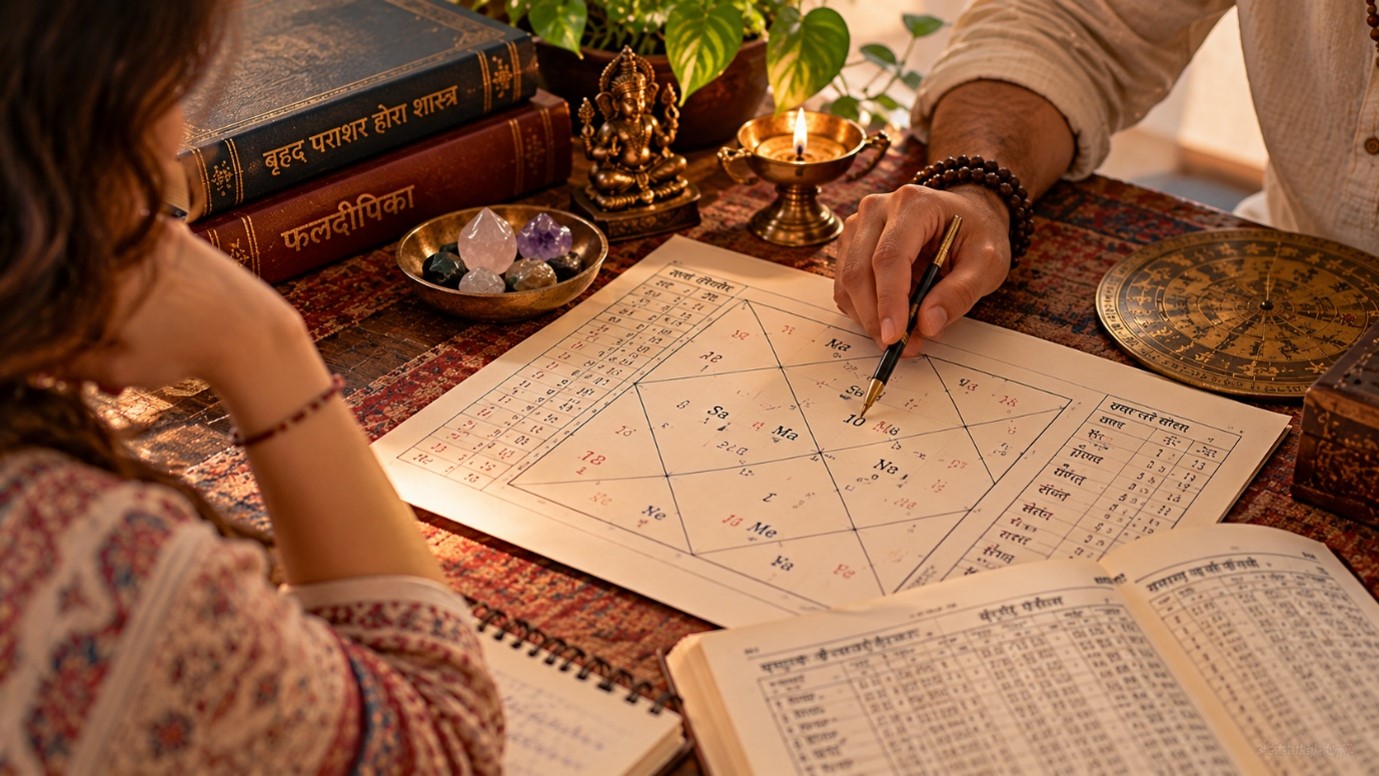
You may know your zodiac sign. You may have read your horoscope, explored your birth chart, or perhaps even discovered systems such as Human Design, numerology or other approaches to self-understanding.
These systems can offer interesting ways of looking at ourselves. But if you have ever felt that a simple description of your personality does not fully explain the complexity of your life, there is another ancient system worth exploring.
It is called Vedic Astrology, traditionally known as Jyotish.
For someone discovering it for the first time, Jyotish can seem quite complex. There are planets, signs, houses, the Ascendant, the Moon, Nakshatras, planetary periods, divisional charts and many other layers of interpretation. But this complexity is also what makes a Vedic birth chart so interesting.
Jyotish is not simply about asking, "What is my zodiac sign?"
It invites much deeper questions. What patterns do I carry? What areas of life are particularly important for me? Why do certain themes seem to repeat? Why does one period of life feel completely different from another? What does my chart traditionally say about my relationships, work, responsibilities, inner nature and spiritual direction?
In this article, we will begin with the basics and gradually explore why Vedic Astrology can offer such a detailed way of looking at a human life.
Table of Contents
1. What Is Vedic Astrology?
Vedic Astrology is the traditional astrological system associated with India. It is commonly known as Jyotish, or Jyotisha.
At its simplest, astrology begins with a very straightforward idea: the positions of celestial bodies are observed in relation to a particular time and place, and those positions are interpreted symbolically within an astrological tradition.
A Vedic birth chart takes the sky at the moment of a person's birth and creates a map from it. Traditionally, astrologers then interpret the relationship between planets, zodiac signs, houses and other factors to understand different aspects of life.
It is important to understand that Jyotish is a traditional cultural and philosophical system, not a modern scientific theory of human behaviour. Modern astronomy describes celestial objects through physical laws, while astrology interprets celestial positions symbolically. The two should not be confused.
Historically, however, the study of Jyotish developed alongside sophisticated traditions of Indian astronomy and calendar-making. Early Jyotisha literature dealt with the movements of the Sun and Moon, lunar days, seasons, calendars and Nakshatras, showing that the history of Indian astral knowledge includes both astronomical and astrological traditions.
For someone approaching Jyotish today, this history provides an important context. It is not simply a modern personality system that was created to describe different types of people.
2. What Does "Jyotish" Mean?
The Sanskrit word Jyotish is often associated with light or illumination.
This gives us an interesting way to understand the purpose of the tradition.
Rather than seeing a birth chart simply as a list of predictions, we can think of it as a symbolic framework for bringing certain patterns into awareness.
A chart does not replace your own experience. You are still the person living the life, making choices, forming relationships and responding to circumstances.
The chart is interpreted as a map.
And like any map, its usefulness depends on how carefully it is read.
3. What Is a Vedic Birth Chart?
Imagine taking a photograph of the sky at the precise moment you were born.
A Vedic birth chart is not literally a photograph, but the analogy can help.
Your birth date provides the day. Your birth time helps establish the position of the Ascendant and the houses. Your birthplace establishes the geographical reference from which the chart is calculated.
The resulting chart shows the positions of the Sun, Moon and other planets used in Jyotish, along with the zodiac signs and houses.
An astrologer then interprets the relationships between these different components.
This is where Jyotish begins to become much more interesting than a simple zodiac-sign description.
There is no single piece of information that has to explain your entire personality or life.
The interpretation comes from the relationship between many factors.
4. Why Do Your Date, Time and Place of Birth Matter?
If you have ever received an astrology reading, you may have been asked for your exact birth time.
There is a reason for this.
The Ascendant, or Lagna, changes relatively quickly compared with the slower-moving planets. Because the Ascendant is used to establish the houses of the chart, differences in birth time can change important parts of a chart interpretation.
This is why a Vedic astrologer may ask not only, "What day were you born?" but also, "What time?" and "Where?"
If the birth time is uncertain, some traditional Jyotish practitioners use methods of birth-time rectification, in which significant life events are considered in an attempt to identify a more suitable birth time. Such methods are themselves part of traditional astrological practice and should not be treated as scientifically established techniques.
The practical lesson is simple: the more accurate the birth information, the more precisely the chart can be calculated.
5. The 12 Zodiac Signs in Vedic Astrology
Most people are already familiar with the twelve zodiac signs.
Aries, Taurus, Gemini, Cancer, Leo, Virgo, Libra, Scorpio, Sagittarius, Capricorn, Aquarius and Pisces.
In Jyotish, these are known as Rashis.
But a sign is only one part of the interpretation.
The same sign can behave very differently depending on which planet is placed there, which house it occupies, what other planets influence it, and how the broader chart is structured.
This is an important principle to understand.
Knowing that someone has a particular sign does not tell you everything about them.
It is the larger configuration that becomes meaningful.
6. The 9 Grahas: More Than Just Planets
One of the words you will encounter frequently in Jyotish is Graha.
The nine traditional Grahas are:
- Surya, the Sun
- Chandra, the Moon
- Mangala, Mars
- Budha, Mercury
- Guru, Jupiter
- Shukra, Venus
- Shani, Saturn
- Rahu
- Ketu
The last two are particularly interesting.
Rahu and Ketu are not physical planets. In astronomical terms, they correspond to the ascending and descending lunar nodes. Within Jyotish, however, they are treated as significant Grahas with their own traditional meanings.
This is another example of why it is useful to understand Jyotish on its own terms rather than trying to translate every concept directly into modern astronomy or psychology.
Each Graha is traditionally associated with different qualities, functions and areas of human experience.
But again, the important point is not simply, "What does Jupiter mean?"
The deeper question is:
Where is Jupiter in the chart? What sign is it in? What house does it influence? What planets are connected with it? What is its strength? What other factors modify its expression?
This is where the layered nature of Jyotish begins to emerge.
7. The 12 Houses: Different Areas of Life
The zodiac signs describe one layer of the chart. The 12 houses, or Bhavas, provide another.
The houses are traditionally associated with different areas of human life.
For example, they are used in interpreting themes related to:
- identity and self
- wealth and resources
- communication
- home and family
- creativity and children
- health and service
- partnerships
- transformation
- higher learning and philosophy
- career and public life
- networks and aspirations
- retreat, spirituality and liberation
This is where a birth chart becomes much more personal.
Instead of simply asking:
"What kind of person am I?"
Jyotish can also ask:
"Which areas of life are receiving the strongest emphasis?"
That is a very different level of inquiry.
8. Why Your Sun Sign Is Only the Beginning
In popular Western astrology, many people identify themselves through their Sun sign.
"I am a Leo."
"I am a Scorpio."
"I am a Pisces."
There is nothing wrong with beginning there, but Jyotish does not stop there.
The Ascendant, Moon, Sun, planets, houses and their relationships are all considered.
This means two people who share the same Sun sign can have very different birth charts.
Their Ascendants may be different. Their Moons may be different. Their planetary placements may be completely different. Their Nakshatras may differ. Their planetary periods may also be different.
This is one of the first things that surprises people when they begin exploring Jyotish.
Your zodiac sign is not your entire chart.
It is one piece of a much larger picture.
9. The Importance of the Moon in Jyotish
The Moon has a particularly important place in Vedic Astrology.
Traditionally, the Moon is associated with the mind, emotional experience, perception, habits and the way we process our surroundings.
This is one reason a Jyotish reading may pay significant attention to the Moon rather than focusing only on the Sun.
Your Moon sign can be considered alongside its house, the Nakshatra it occupies, the planets influencing it and other factors in the chart.
For someone coming from a Western astrology background, this can be an interesting shift in perspective.
Instead of asking only:
"Who am I?"
Jyotish can also invite questions such as:
"How do I experience the world?"
"What patterns does my mind tend to return to?"
"What influences my emotional experience?"
These are different questions, and they create a richer conversation.
10. What Are Nakshatras?
If you are new to Vedic Astrology, Nakshatras may be one of the most fascinating concepts you encounter.
The zodiac is traditionally divided into 27 Nakshatras, or lunar mansions.
The Moon's position in a particular Nakshatra is given considerable importance in many Jyotish traditions.
Each Nakshatra has its own symbolism, mythology, planetary ruler and traditional qualities.
This gives Jyotish another layer of interpretation beyond the twelve zodiac signs.
Think about the difference.
Twelve zodiac signs give one level of classification.
Twenty-seven Nakshatras provide another, more finely divided framework.
This does not automatically make every interpretation more accurate in a scientific sense. But it does show why Jyotish can offer a more granular traditional framework for interpreting a birth chart.
The Nakshatra system has deep historical roots in Indian astronomical and calendrical traditions. Early Jyotisha texts used Nakshatras in tracking the positions and movements of the Sun and Moon.
11. Why Jyotish Can Feel So Detailed
Now we can come back to the question at the heart of this article.
Why can Vedic Astrology feel so detailed?
Because the astrologer is not usually looking at only one factor.
A reading can bring together:
Ascendant + houses + planets + signs + Moon + Nakshatra + planetary relationships + Yogas + divisional charts + Dashas + transits.
Each layer asks a slightly different question.
The Ascendant helps establish the framework of the chart.
The houses describe areas of life.
The planets provide traditional symbolic significations.
The signs modify how those planets express themselves.
The Nakshatras add another layer of detail.
Yogas examine particular combinations.
Divisional charts provide additional traditional perspectives.
Dashas examine planetary periods.
Transits bring the current sky into the interpretation.
This is why a serious Jyotish reading is very different from reading a daily horoscope.
12. Beyond Personality: What Can Jyotish Explore?
One of the things I find most interesting about Jyotish is that it does not have to stop at personality.
Traditionally, astrologers have used birth charts to explore many areas of life.
A person may want to understand their relationships or partnership patterns. Another may be interested in career and vocation. Someone else may be going through a major transition and want to understand the planetary period they are currently experiencing.
Others may come to Jyotish with deeper questions.
Why do certain themes keep appearing in my life?
Why do I feel drawn towards spiritual practices?
Why does one period of my life feel completely different from another?
What does my chart traditionally suggest about Dharma?
These questions move astrology away from simple personality descriptions and towards a broader contemplation of life.
13. Yogas: When Different Factors Come Together
Another important concept is Yoga.
In Jyotish, the word Yoga can refer to particular combinations of planetary or chart factors that are traditionally interpreted as having specific effects or themes.
This is important because planets are not always interpreted independently.
A planet can have one meaning on its own, but its relationship with another planet, its position in a particular house, or a specific combination can change how an astrologer understands its role.
This is similar to reading a sentence rather than looking at individual words.
One word can have a particular meaning.
But when several words come together, the meaning becomes more specific.
Yogas are one of the many reasons Jyotish requires interpretation rather than simply looking up the meaning of one planet.
14. Divisional Charts: Looking Deeper
If you continue studying Jyotish, you eventually encounter Varga, or divisional charts.
This is another area that many people outside traditional Indian astrology have never encountered.
The main birth chart provides the foundation, while divisional charts are traditionally used to examine particular dimensions of life in greater detail.
One of the best known is the Navamsa, or D9 chart.
Rather than attempting to explain every divisional chart in a beginner's article, it is enough to understand the basic principle:
Jyotish has additional chart frameworks that allow an astrologer to examine specific themes through another traditional lens.
This is another example of why a complete Jyotish reading can become considerably more detailed than a simple zodiac-sign reading.
15. Dashas: Understanding Different Periods of Life
This may be one of the most fascinating aspects of Jyotish for someone discovering it for the first time.
Your birth chart is not treated simply as a static picture.
Traditional Jyotish also has systems for examining planetary periods, known as Dasha systems.
One of the best-known is Vimshottari Dasha.
The basic idea is that different planetary periods become active at different stages of life, and astrologers interpret those periods in relation to the person's birth chart.
This introduces a completely different question.
Instead of asking only:
"What is my personality?"
you can ask:
"What themes may be active in my life during this period?"
This is particularly interesting when someone looks back at their life and notices that major changes often seem to happen in chapters.
A new career.
A major relationship.
A period of study.
A move to another country.
A spiritual transformation.
A difficult transition.
A completely new direction.
Traditional Jyotish uses Dasha systems as one framework for examining such periods.
16. Transits and the Timing of Change
Dashas are not the only timing tool.
Astrologers also examine planetary transits, meaning the current movement of planets in relation to the birth chart.
The birth chart provides the foundation.
The planetary periods provide one layer of timing.
The current planetary movements provide another.
When these layers are considered together, the astrologer can explore not only what is traditionally associated with a person's chart, but also when certain themes may become more prominent.
This emphasis on timing is one of the features that many people find particularly interesting when they first encounter Jyotish.
17. Vedic Astrology and Human Design
Today, people explore many different systems for self-understanding.
Some are familiar with Western Astrology. Others have explored Human Design, Gene Keys, numerology or different spiritual frameworks.
Human Design, for example, uses concepts such as Types, Authority, Profiles, Centers, Gates and Channels within its BodyGraph system. These are part of the system's own terminology and structure.
If you have encountered Human Design, you may already be familiar with the experience of receiving a highly personalised map that gives you a language for understanding yourself.
Jyotish offers a different kind of map.
Its traditional framework brings together planets, signs, houses, Nakshatras, planetary combinations, divisional charts and timing systems.
The two systems should not necessarily be treated as competing versions of the same thing. They come from different historical and conceptual backgrounds and ask somewhat different questions.
But if what you are looking for is a traditional astrological system with many interconnected layers of interpretation, Jyotish offers considerable depth.
18. Is Vedic Astrology More Detailed Than Modern Self-Discovery Systems?
This is where we need to make an important distinction.
It would be too simplistic to say that one system is objectively "better" or "more accurate" than another. There is no established scientific method that demonstrates that Vedic Astrology is more accurate than Human Design or another spiritual framework.
But we can make a different observation.
Jyotish has an exceptionally layered traditional structure.
A reading can move from the broad structure of the birth chart into signs, houses, planetary relationships, Nakshatras, Yogas, divisional charts and timing techniques.
That means the astrologer has many different dimensions through which to examine the same life.
For someone who has only experienced a basic Sun-sign horoscope, the difference can feel enormous.
And even for someone who has explored Human Design or another detailed self-discovery system, Jyotish can introduce a completely different way of looking at the relationship between personality, life circumstances, cycles and time.
The value is not necessarily in choosing one system and rejecting everything else.
Sometimes a new system simply gives you a different question to ask.
19. Karma, Dharma and Free Will
This is where Jyotish moves beyond charts and calculations and enters a deeper philosophical territory.
Indian traditions have long explored ideas of Karma and Dharma, and these concepts can appear in the way Jyotish is interpreted.
Karma is often misunderstood as a simple system of reward and punishment.
The traditional philosophical idea is much more nuanced.
Dharma can also be understood in different ways depending on the philosophical context, but it is broadly associated with one's duties, principles, responsibilities and way of living in accordance with a deeper order.
When these ideas are brought into Jyotish, the birth chart can be viewed as describing certain tendencies and circumstances rather than removing the possibility of choice.
This distinction matters.
I do not believe a person should look at their birth chart and think:
"This is my destiny, so I have no choice."
A chart can be used as a mirror.
Awareness gives you the opportunity to respond differently.
This is also where astrology can become much more meaningful than simply asking what will happen next.
20. Can Vedic Astrology Predict the Future?
This is one of the first questions most people ask.
The traditional answer is that Jyotish has developed predictive techniques involving planetary positions, Dashas, transits and other chart factors.
But prediction should not be confused with absolute certainty.
A responsible reading should not create unnecessary fear or convince someone that every event in their life is fixed and unavoidable.
There is also a difference between saying:
"This exact event will definitely happen."
and saying:
"This period is traditionally associated with these themes, so this may be an important time to pay attention to this area of life."
The second approach leaves room for awareness, context and human choice.
For me, that distinction is extremely important.
21. What Can You Ask in a Vedic Astrology Consultation?
You do not need to come to a consultation with one particular question.
Sometimes the most valuable question is simply:
"What does my chart show about the patterns I am currently living through?"
But you may also want to explore specific areas.
Relationships
Why do certain relationship patterns seem to repeat?
What does the chart traditionally suggest about partnership?
Career
What kinds of work may align with my natural tendencies?
Why do I feel unfulfilled in a particular professional direction?
What planetary period am I currently experiencing in relation to career?
Life Direction
What does my chart traditionally suggest about Dharma and purpose?
Why am I drawn towards certain subjects or ways of living?
Life Transitions
Why does this particular phase of my life feel so different?
Is there a traditional Jyotish explanation for the timing of major changes?
Spirituality
Why do I feel increasingly drawn towards meditation, yoga or spiritual practice?
What does my chart traditionally suggest about spiritual inclination?
These questions make a consultation much more personal than simply asking, "What does my future look like?"
22. My Approach to Vedic Astrology
For me, Vedic Astrology is not about giving someone a list of things that will supposedly happen to them.
I see the birth chart as a framework for understanding patterns.
When I work with a chart, I want to look beyond isolated planetary placements and understand how the different parts of the chart relate to one another. The Ascendant, Moon, planets, houses, Nakshatras, planetary periods and other relevant factors can all contribute to the interpretation.
I also believe that the person sitting in front of me matters just as much as the chart.
A birth chart should not be interpreted without listening to the actual life of the person.
If someone is going through a major transition, the consultation should create space to understand that experience rather than forcing everything into a predetermined prediction.
My intention is not to take away someone's power by telling them what they must do.
It is to offer another perspective.
Sometimes the chart confirms something you already intuitively know. Sometimes it gives you a completely new way of looking at a situation. And sometimes it simply helps you ask a better question.
For me, that is where the real value of Jyotish begins.
23. Final Thoughts
Perhaps the most interesting thing about Vedic Astrology is that it does not ask you to understand yourself through just one label.
You are not simply your Sun sign.
You are not simply your Moon sign.
You are not simply your Ascendant.
And even the birth chart itself is not a single answer.
It is a collection of relationships.
Planets interact with signs. Signs occupy houses. The Moon moves through Nakshatras. Planetary combinations create different traditional Yogas. Divisional charts offer additional perspectives. Dashas introduce the dimension of time, while transits bring another layer of movement.
When these elements are studied together, Jyotish becomes a remarkably elaborate symbolic language.
For someone who has only encountered newspaper horoscopes, this can feel completely different.
For someone who has explored Western Astrology, Human Design or other systems of self-discovery, it can open another door.
And perhaps the real value is not in finding one system that explains everything.
It is in becoming more curious about yourself.
Your patterns.
Your relationships.
Your choices.
Your challenges.
Your strengths.
The periods of life when everything seems to change.
And the deeper question of what you want to do with the life you have been given.
Vedic Astrology cannot make those decisions for you.
But, when approached thoughtfully, it can give you another language through which to explore them.
And sometimes, a different perspective is enough to help you see something that was already there.
24. Frequently Asked Questions
Is Vedic Astrology the same as Indian Astrology?
Vedic Astrology is commonly used in English to refer to the Indian tradition of Jyotish. The terminology can vary, and Jyotish itself encompasses a broader historical field than what is sometimes presented online as simply "Vedic Astrology."
Is Vedic Astrology the same as Western Astrology?
No. They are different astrological traditions with different historical developments, technical frameworks and methods of interpretation. One well-known difference is the zodiac framework commonly used, with Jyotish generally using a sidereal zodiac while modern Western astrology commonly uses a tropical zodiac.
Why is my Vedic zodiac sign different from my Western zodiac sign?
The two traditions commonly use different reference systems for the zodiac. Because of this, the sign assigned to a planet can sometimes be different between a Western tropical chart and a Vedic sidereal chart.
What are Nakshatras?
Nakshatras are 27 traditional lunar divisions used in Jyotish. The Moon's position among them is particularly important in many forms of Vedic Astrology.
What are Rahu and Ketu?
Rahu and Ketu correspond astronomically to the lunar nodes, where the Moon's orbit intersects the apparent path of the Sun. In Jyotish, they are treated as significant Grahas and have extensive traditional interpretations.
Do I need my exact birth time?
An accurate birth time is particularly useful because the Ascendant and houses depend on the time and place of birth. If the birth time is uncertain, some astrologers use traditional rectification methods, although these are not scientifically established methods.
Can Vedic Astrology tell me about my career?
Career is one of the areas traditionally explored through Jyotish. Astrologers may consider the relevant houses, planets, signs, Yogas, divisional charts and planetary periods rather than relying on one placement alone.
Can Vedic Astrology predict marriage?
Marriage and partnership are traditionally examined through several chart factors and timing techniques. A responsible reading should be presented as an interpretation of traditional astrological indicators rather than an absolute guarantee about a particular event.
Can someone outside India have a Vedic Astrology reading?
Absolutely. Jyotish is based on birth information, not nationality. A person born in Europe, America, Australia, South America or anywhere else can have a Vedic birth chart calculated and interpreted within the Jyotish tradition.
Do I need to believe in astrology for a consultation?
Not necessarily. You can approach a consultation with curiosity rather than certainty. You can explore the framework, ask questions and decide for yourself what is meaningful.