What Is a Chakra & Body Scan? Understanding Your Energy, Aura, Body and Wellbeing Through Digital Assessment
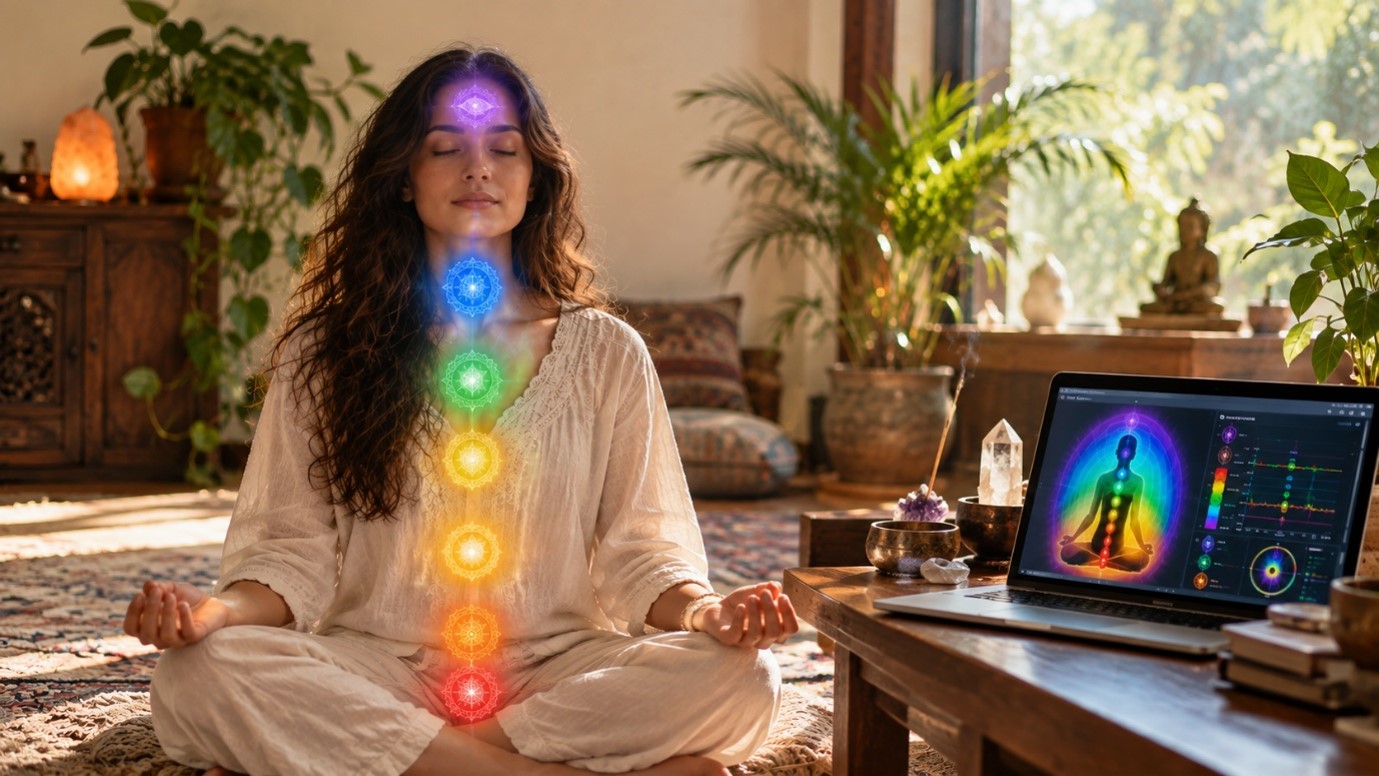
We are increasingly interested in understanding our health and wellbeing in more personalized ways. We check our sleep, heart rate, activity levels and other health indicators, but there are also traditional systems that have long encouraged people to observe the body, energy and mind as interconnected aspects of life.
A Chakra & Body Scan brings several of these perspectives together through a digital wellness assessment. It can combine measurable physiological information, including Heart Rate Variability (HRV), with traditional wellness frameworks such as the seven chakras, aura, Ayurvedic Doshas, meridians, body-system patterns, vitality and biological age.
For someone who has been feeling stressed, mentally overloaded, low in energy, disconnected from themselves, or simply curious about their current state, this can offer a fascinating new way to explore personal wellbeing.
So, what exactly is a Chakra & Body Scan, and what might you discover when you see your own results?
Table of Contents
1. What Is a Chakra & Body Scan?
A Chakra & Body Scan is a digital wellness assessment designed to provide a broader picture of your current state by bringing together different types of information.
One part of the assessment looks at physiological indicators, including information related to heart rate and Heart Rate Variability (HRV). Other areas explore traditional wellness frameworks involving the chakras, aura, Ayurvedic Doshas, meridians and different aspects of vitality.
The idea is to look at wellbeing from several perspectives rather than focusing on only one aspect of the person.
You may become curious about your stress patterns, your HRV, your chakra patterns, your Ayurvedic constitution, your energy field or your vitality.
The result is a personalized assessment that can become a starting point for deeper self-exploration.
2. Why Explore Your Wellbeing in a Different Way?
Most of us are familiar with conventional ways of looking at the body.
We may know our weight, blood pressure, blood sugar or other health measurements. We may also notice how much we sleep, how active we are and how energetic we feel.
But there are many aspects of our daily experience that are harder to put into words.
You may feel that your mind is constantly active. You may wake up tired even after sleeping. You may feel physically fine but emotionally depleted. You may sense that your lifestyle has become too demanding but struggle to understand exactly where the imbalance is coming from.
A broader wellness assessment can give you another perspective.
It can help turn some of these vague questions into something more tangible that you can explore and discuss.
3. How Does a Digital Body Assessment Work?
A digital assessment collects physiological information from the body and processes that information to generate a structured set of wellness indicators.
The results can then be presented across different areas, allowing you to explore physiological patterns alongside traditional frameworks such as chakras, aura, Doshas and meridians.
The process is designed to be simple and non-invasive.
You do not need to spend a long time filling out complicated questionnaires before beginning. The assessment gathers the relevant information and produces a personalized report that can then be explored in greater detail.
What makes the experience particularly interesting is that the results are personal to you.
Instead of reading a general article about Vata or the Root Chakra, you can explore what your own assessment shows.
4. What Is HRV and Why Is It Interesting?
One of the physiological measures associated with this type of assessment is Heart Rate Variability, or HRV.
HRV refers to the natural variation in the time interval between consecutive heartbeats. A healthy heart does not normally beat at exactly identical intervals like a metronome. The timing changes from beat to beat.
HRV is influenced by the autonomic nervous system and is therefore of interest in research involving physiological regulation, stress, recovery and cardiovascular function.
It is important to understand that HRV is not simply the same thing as heart rate.
Two people can have a similar heart rate while showing different patterns of beat-to-beat variability.
HRV can also be influenced by many factors, including sleep, physical activity, breathing, age, medications and overall physiological condition. For this reason, it is most useful when understood as one piece of information within a broader picture rather than as a standalone measure.
The science around HRV is one reason physiological information can add an interesting dimension to a wellness assessment.
5. Understanding Stress and Physiological Balance
Stress affects more than our thoughts.
When we experience demands or pressure, the body can respond through changes in heart rate, breathing, muscle tension, attention and autonomic activity.
This is one reason modern research increasingly looks at the relationship between mental and physical wellbeing.
Yoga and other mind-body practices have also been studied for stress management and general wellbeing. Research summarized by the U.S. National Center for Complementary and Integrative Health suggests that yoga may support stress management, sleep and mental and emotional wellbeing, although the strength of evidence varies between conditions and practices.
A physiological assessment can therefore provide another perspective on your current state.
It may encourage you to become more curious about your sleep, breathing, recovery, activity and daily routine.
Sometimes the first step toward change is simply becoming more aware of a pattern.
6. Exploring the Seven Chakras
The chakra system is one of the most widely known concepts from the yogic and tantric traditions.
The commonly used seven-chakra model describes:
- Muladhara, Root Chakra
- Svadhisthana, Sacral Chakra
- Manipura, Solar Plexus Chakra
- Anahata, Heart Chakra
- Vishuddha, Throat Chakra
- Ajna, Third Eye Chakra
- Sahasrara, Crown Chakra
Traditionally, chakras are described as subtle centres associated with different dimensions of human experience.
A Chakra & Body Scan provides a way to explore patterns associated with these centres through a personalized assessment.
For someone already practising Yoga, meditation, breathwork or energy work, this can provide an additional perspective on their practice.
For someone completely new to chakras, it can be a fascinating introduction to the traditional yogic understanding of the subtle body.
7. What Does an Aura Assessment Explore?
The aura is traditionally described in various spiritual and energetic traditions as a subtle field surrounding or extending from the body.
Different traditions interpret the aura in different ways. It is not the same thing as a conventional biomedical measurement or a universally defined physiological structure.
Within a holistic wellness setting, an aura assessment provides an energetic perspective that can be explored alongside the other information in the scan.
For people interested in energy work, chakras, meditation and spiritual practices, this can be one of the most intriguing aspects of the experience.
Instead of simply discussing the idea of an energy field, the assessment gives you a personalized representation to explore with Mahesh Ji.
8. Understanding Your Ayurvedic Dosha
Another fascinating dimension is the Ayurvedic understanding of Vata, Pitta and Kapha.
Ayurveda describes these as three Doshas, traditionally associated with different combinations of the five elements and different functional qualities.
Vata is associated with movement and change.
Pitta is associated with transformation.
Kapha is associated with stability, structure and cohesion.
According to traditional Ayurveda, everyone has all three Doshas, although their relative expression differs from person to person.
The assessment provides an opportunity to explore this traditional framework in relation to your own results.
This can lead to questions such as:
What is my Ayurvedic constitution?
Which Dosha appears more prominent?
What does this mean within the Ayurvedic framework?
How might my lifestyle be supporting or challenging my natural patterns?
For many people, this becomes the starting point for a deeper exploration of Ayurvedic lifestyle and daily routine.
9. Exploring Organs and Body Systems
The assessment can also explore patterns associated with different organs and body systems.
This adds another dimension to the experience because the body functions as an interconnected system rather than as a collection of completely separate parts.
Your digestion, breathing, circulation, energy, activity and recovery all exist within the larger context of your lifestyle.
Exploring these areas can make you more curious about your own body.
Perhaps you have been paying attention to your digestion but never considered it in relation to your overall wellbeing. Perhaps you have been experiencing low energy and want to understand more about your current patterns.
The scan can provide information that becomes a starting point for further conversation and self-awareness.
10. Meridians and Energy Pathways
Another traditional framework that may appear in the assessment is the system of meridians.
In Traditional Chinese Medicine, meridians are described as pathways through which Qi, or vital energy, circulates.
The meridian system is distinct from the Ayurvedic chakra system, but both provide traditional ways of thinking about the relationship between the body and subtle energy.
For someone interested in Ayurveda, Yoga, acupuncture, Traditional Chinese Medicine or energy practices, exploring these different perspectives can be particularly interesting.
It allows you to see your wellbeing through more than one traditional framework.
11. Biological Age and Vitality
Another area that naturally attracts curiosity is biological age.
Your chronological age is simply the number of years you have lived.
Biological age is a broader and more complex concept. Modern research uses different biomarkers and models to estimate aspects of physiological ageing, and there is no single universal method for determining biological age.
Within a wellness assessment, a biological-age indicator can provide another perspective on vitality and the current state of the body.
This naturally raises an interesting question:
How does my current vitality compare with my chronological age?
For some people, the result may simply satisfy curiosity. For others, it may encourage greater attention to sleep, movement, nutrition, stress management and recovery.
12. Bringing Different Perspectives Together
What makes a Chakra & Body Scan particularly interesting is the combination of different perspectives.
There is the physiological side, including measures such as HRV.
There is the Ayurvedic perspective, with Vata, Pitta and Kapha.
There is the yogic perspective, with the seven chakras and subtle-body concepts.
There is the energetic perspective, including aura patterns.
There is also the meridian perspective, associated with Traditional Chinese Medicine.
And there are additional indicators related to vitality and biological age.
Each framework uses a different language.
Together, they can create a broader conversation about how you experience your body, energy, lifestyle and wellbeing.
13. What Can You Discover From Your Personal Report?
This is where the experience becomes truly personal.
Instead of simply reading about the chakras, Doshas or HRV, you can explore information generated from your own assessment.
You may become curious about your stress patterns.
You may want to understand your HRV.
You may discover particular chakra patterns that you want to explore through meditation or Yoga Nidra.
You may become interested in your Ayurvedic constitution.
You may want to learn more about your energy field or vitality.
The report can therefore act as a personal map for further exploration.
It can open questions that you may never have thought to ask about yourself.
14. From Information to Self-Awareness
Information becomes meaningful when it helps you become more aware of your own patterns.
Perhaps the assessment makes you more conscious of how much stress you are carrying.
Perhaps it sparks an interest in breathwork.
Perhaps your chakra patterns encourage you to explore meditation.
Perhaps your Ayurvedic profile leads you toward learning more about food, digestion and daily routine.
Perhaps the results simply make you pause and think about how you have been living.
This is where a scan can become more than an interesting experience.
It can become a starting point for greater self-awareness and more conscious choices.
15. How Mahesh Ji Uses the Scan
The Chakra & Body Scan is not intended to be a report that you simply receive and try to interpret on your own.
The detailed exploration of your results takes place when you book a consultation with Mahesh Ji to understand the report, receive personalized health and lifestyle guidance, or work more deeply on your wellbeing and healing journey.
During the consultation, Mahesh Ji can explore the different areas of the report with you, including physiological indicators, HRV, chakras, aura, Ayurvedic Doshas, meridians, vitality and other areas included in the assessment.
The report can then become a starting point for a more personalized conversation.
Depending on your individual goals, the consultation may lead toward Ayurveda, Yoga, Pranayama, Meditation, Yoga Nidra, Chakra work, energy practices or personalized lifestyle guidance.
The intention is to move beyond simply looking at information and understand how the different patterns may relate to your present lifestyle and personal goals.
The scan gives you information. The consultation with Mahesh Ji helps you explore and understand that information in a personalized way.
16. What Happens During a Chakra & Body Scan?
The process itself is simple and comfortable.
You arrive for your session, settle in, and undergo the digital assessment. Physiological information is collected and processed to create your personalized set of results.
The assessment can provide information across multiple areas, including HRV, physiological indicators, chakras, aura, Ayurvedic Doshas, meridians, vitality and other wellness parameters.
If you would like to understand your results in detail, receive personalized wellness guidance, or explore a healing journey with Mahesh Ji, you can book a consultation.
During the consultation, Mahesh Ji can take you through the relevant areas of your report, explain the different patterns and explore the areas that are most meaningful for you.
Depending on what you are looking for, the consultation can become the beginning of a personalized journey involving Ayurveda, Yoga, Pranayama, Meditation, Yoga Nidra, Chakra work, energy healing or lifestyle guidance.
The scan is therefore not just about collecting information. It is an opportunity to discover, explore and understand more about yourself.
17. Who May Be Interested in a Chakra & Body Scan?
You do not need to be an expert in Yoga, Ayurveda or energy work to experience a Chakra & Body Scan.
It may be particularly interesting for:
- People curious about their overall wellbeing
- People interested in chakras and aura
- Yoga and meditation practitioners
- People interested in Ayurveda and Doshas
- People curious about HRV and physiological patterns
- People currently doing a Yoga Teacher Training Course (TTC) and curious to explore their own body and energy patterns
- People who have completed a Yoga Teacher Training Course and want to deepen their personal understanding of Yoga, chakras, Ayurveda and wellbeing
- Wellness travellers visiting Rishikesh
- Spiritual and holistic wellness seekers
- Healers and wellness practitioners
- People interested in stress and relaxation
- Anyone curious to discover something new about themselves
For Yoga TTC students and graduates especially, the scan can be an interesting way to connect what they are learning through Yoga with their own personal experience of the body, breath, energy and wellbeing.
You do not need to arrive with a specific problem.
Sometimes curiosity itself is a good reason to look within.
18. Final Thoughts
We spend a great deal of time trying to understand the world around us, yet often very little time exploring our own patterns.
A Chakra & Body Scan offers an opportunity to pause and look at yourself through several different perspectives.
There is measurable physiological information, including HRV. There are also traditional systems such as Ayurveda, chakras, aura and meridians that offer different ways of exploring the human experience.
The most interesting part may not simply be seeing the results.
It may be the questions the results create.
What is my body showing me?
What are my current stress and vitality patterns?
What do my chakra and aura patterns look like?
What does Ayurveda suggest about my constitution?
What areas of my lifestyle could I explore more deeply?
Sometimes, seeing information about yourself in a new way can be the beginning of a much deeper conversation with yourself.
Discover your patterns. Explore your energy. Understand yourself more deeply.
19. Frequently Asked Questions
What is a Chakra & Body Scan?
A Chakra & Body Scan is a digital wellness assessment that brings together physiological information and traditional wellness frameworks such as chakras, aura, Ayurvedic Doshas and meridian patterns.
What is HRV?
HRV stands for Heart Rate Variability. It refers to the natural variation in the time between consecutive heartbeats and is influenced by the autonomic nervous system and other physiological factors.
Why is HRV included in the scan?
HRV provides a measurable physiological indicator that can be explored alongside other information related to stress, recovery and overall wellbeing.
Can the scan explore my chakras?
Yes. The assessment provides personalized patterns associated with the seven primary chakras, allowing you to explore the traditional chakra system in relation to your current assessment.
What is an aura assessment?
Aura is traditionally described as a subtle energetic field associated with a person. An aura assessment provides an energetic perspective that can be explored alongside other areas of the scan.
Can the scan show my Ayurvedic Dosha?
The assessment includes an Ayurvedic perspective involving Vata, Pitta and Kapha, which can then be explored further through personalized Ayurvedic guidance.
What areas are included in the scan?
The assessment can include areas such as HRV, physiological indicators, stress-related patterns, chakras, aura, Ayurvedic Doshas, meridians, organs and body systems, vitality and biological-age indicators.
Do I need to know about chakras or Ayurveda before doing the scan?
No. The assessment is suitable for beginners. You can explore the different concepts during your consultation with Mahesh Ji.
What happens during the consultation?
Mahesh Ji explores the relevant areas of your report with you and can provide personalized guidance based on your goals. Depending on your needs, this may include Ayurveda, Yoga, Pranayama, Meditation, Yoga Nidra, Chakra work, energy practices or lifestyle guidance.
Where can I experience a Chakra & Body Scan?
Chakra & Body Scan sessions are available with Mahesh Ji in Rishikesh.